What is Retinitis Pigmentosa?
Retinitis pigmentosa (RP) is a group of inherited conditions affecting the retina. It can cause progressive loss of night vision and peripheral vision. The age at onset and the course of vision loss vary between people.
Read the National Eye Institute’s RP overview for general background, and discuss your diagnosis with an eye specialist.
Epidemiology
Worldwide there are more than five million people suffering from various forms of Retinitis Pigmentosa Cure. Often; RP appears in childhood / adolescence or in the middle ages with first symptom night blindness ; visual field and vision acuity decrease progressively. Most often the deterioration process is gradually. However; it can also lead to blindness stage very quickly. Slow deterioration of the disease is often associated with a physical concern. Almost sixty percent of RP patients develop cataract until adulthood.
Retinitis Pigmentosa Cure is a form of retinal dystrophies, and is caused by irregularity of photoreceptors ( rod and cone cells) or the retinal pigment epithelium of the retina ; giving rise to continuous vision loss and blindness.
There are two types of receptor dystrophies:
Rod dystrophy
Patients suffering from rod dystrophy have peripheral sight loss. These are the patients with tunnel vision. Night blindness stands in foreground.Cone dystrophy
(dystrophy of cone cells, which are responsible for both central and color vision)
RP patients with cone dystrophy develop central vision loss and poor color vision.
There are many patients suffering from Rod-Cone dystrophy and both their peripheral and central vision are deteriorated or deteriorate gradually.
Signs, symptoms and Prognose of Retinitis Pigmentosa
- Night blindness and Nyctalopia (insufficient adaptation to darkness)
- Longer adaptation time (slow adjustment from dark to light or the opposite)
- most often patients with RP can read white letters from black background better.
- insufficient color discrimination ; failure of color perception
- flickering vision ( Latticework vision)
- blurring of vision
- tunnel vision ( only central vision ; inability of peripheral sight)
- peripheral vision ( inability of central vision; patients can’t see the details and have reading difficulties)
- Visual field impairment, particularly in peripheric vision. Central vision survives at the beginning which causes tunnel vision. After the impairment of peripheric vision; central vision start to be deteriorated and this results in blindness at the end.
- Myopie Magna ( high degrees of myopia ;more than 6 dpt ; not only far distance impairment but patients can also can’t see objects clearly that are away from 1 meter )
- Astigmatism
- Flashes and lightning in vision
In general , first symptom appearing is night blindness ,vision impairment and a slow decrease of visual field until a very tiny tunnel vision. In time the disease leads to blindness. Because of night blindness and always more declining tunnel vision ; after a particular time patients can not move alone without orientation strategies.
Retinitis Pigmentosa is a disease characterised by dysfunction of the light sensing photoreceptor cells (rod and cone cells) .Usually the rod cells ( responsible for night vision) are damaged at first, which explains why night blindness the first symptom is .Daytime vision loss ( cone cells are responsible for daytime vision ) doesn’t appear until the later stages of the disease. Stippling of the retinal pigment epithelium with black bone-spicule pigmentation is typically pathognomonic of retinitis pigments . Other ocular features are waxy pallor of the optic nerve head, attenuation( thinning) of the retinal vessels , cystic macular inflammation ( oedema) and posterior subcapsular cataract.
Complications:- Cataract
- cystic macular inflammation and macular degeneration
- Myopic
- Astigmatism
- Nystagmus
- Glaucoma
- Keratoconus
Genetic
More than 150 Gene play an important role in pathogenesis of Retinitis Pigmentosa. Most of the so far identified genes have a monogenetic inheritance, which means the defect of just one gene can lead to Retinitis Pigmentosa, whereas more genes together can also cause the same problem. The disease can follow through autosomal rezessive, dominant and gonosomal inheritance.
How do the mutations effect?
Some mutations operate through photoreceptors. These mutations have a destructive or function ruining effect on the receptor cells. Some photoreceptor cells are killed due to apoptosis where some of them just lose their function.
Other mutations have an affect on the function of RNA Splycing Complex.
Besides mutations; the disturbance of retinal blood vessels cause impairment of disease.

Associated conditions with Retinitis Pigmentosa Cure
RP is seen in a variety of diseases combined. Beside eyes there are also other organs involved with these syndromes. Therefore we can say, that Retinitis Pigmentosa Cure is a systemic disease. Some well known with RP combined symptoms are hearing disorders, paralysis, muscle weakness, migraine etc.
The most well known Syndroms are:
Usher Syndrom
Retinitis Pigmentosa combined with congenital or progressive deafness. There are three types of Usher Syndrome.- Usher Syndrome typ 1 : typ1 is the heaviest of all types. Patients are deaf from birth and Retinitis Pigmentosa can be until 10th year diagnosed.
- Usher Syndrome typ 2 : there is a constant remaining but severely deafness, and RP will during adolescence diagnosed.
- Usher Syndrome typ 3 : this is a mild form of Usher Syndrome and Retinitis Pigmentosa will most probably only in second half of life diagnosed.
Usher Syndrome treatment :
With our treatment of electro-acupuncture we successfully treat all types of Usher Syndrome. We have significant improvements on deafness and night blindness ( Retinitis Pigmentosa )
Bardet Biedl Syndrome :
Laurence Moon Bardet Biedl Syndrome is also a genetic disease.Bardet-Biedl Syndrome characteristics:
- Obesity
- Diabetes Mellitus
- Hypertension
- Hypogenesis of Penis etc. ; Hypogonadism
- Retinitis Pigmentosa and therefore resulting blindness
- cognitive disability ( mental retardation )
- polydactily (more than five fingers ; usually six)
Treatment of Bardet-Biedl Syndrome
Our technique provides significant improvements on obesity, Retinitis Pigmentosa , hypertension of Bardet Biedl Syndrome.
Refsum Syndrome
Over-Accumulation of Phytanic Acid in cells and tissues causes Refsum Disease. Patients with Refsum Disease may have several different degrees of neurologic damage and peripheral neuropathy. In common; the disease appears in childhood/adolescence with a progressive course. Symptoms also may include ataxia, hearing difficulties and eye problems such as cataracts, night blindness ( Retinitis Pigmentosa).With our treatment there has been significant improvement seen on Retinitis Pigmentosa ( larger visual field , improved vision acuity etc ) and on phytanic acid levels. We have determined that the other neurologic and skin issues have also improved during our treatment.
Alport Syndrome
Alport syndrome is a genetic disorder characterised by glomerulonephritis, and hearing loss. It can also affect the eyes. Hematuria is almost always present in the urine (blood in the urine due to glomerulonephritis) Some patients can also suffer from Retinitis Pigmentosa associated with Alport Syndrome.Diagnosis and ongoing care
Assessment may include a dilated eye examination, visual field testing, retinal imaging, electroretinography and genetic testing. Your eye specialist can explain which tests are relevant to your situation.
Low-vision aids, rehabilitation and regular eye examinations can support ongoing care. Source: National Eye Institute.

Care options and treatment research
Care and research options depend on the diagnosis. Distinguish established care, treatments for specific genetic conditions and experimental approaches when discussing your options with a retinal specialist.
Gene therapy: a specific indication
The FDA lists LUXTURNA for patients with confirmed biallelic RPE65 mutation-associated retinal dystrophy. Patients must have viable retinal cells as determined by the treating physician. This is not a treatment for every form of RP.
This approval does not establish the effectiveness of electro-acupuncture and does not mean that Fıratlı Clinic provides LUXTURNA.
Discussing care and research
Ask your retinal specialist about available care, the evidence for a proposed intervention and whether a research study is relevant to your diagnosis. Study participation and treatment eligibility require individual assessment.
Read how Fıratlı Clinic describes its method and ask the clinic about evidence, limitations and follow-up.
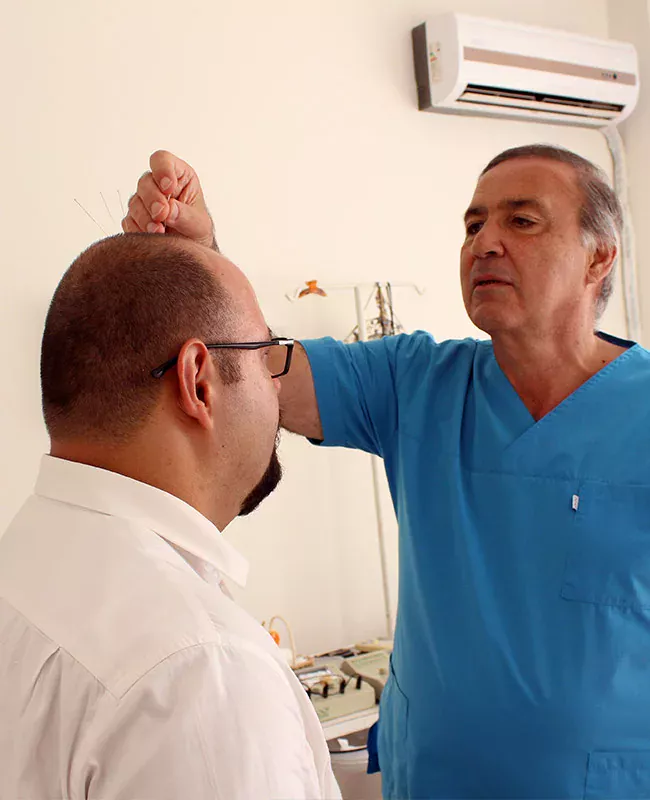
Retinitis Pigmentosa Treatment in our clinic with Dr. Osman Firatli Methode
A very successful treatment for Retinitis Pigmentosa (rod-cone dystrophy) was first applied by Dr.Osman Firatli in our clinic.
We believe that our medically proven Success and the results of the treatment are much more precious than thousand words. These visual fields are thousandfold documented and can be called anytime if the patients request in this respect.
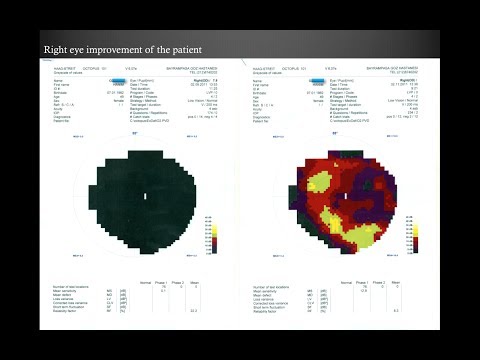
We have presented this by ourselves developed method in several World-Congresses many times.
ICMART 2007 Barcelona / Spain
ICMART 2008 Budapest / Hungary
ICMART 2009 Thessaloniki / Greece
ICMART 2010 Riga / Latvia
ICMART 2011 Den Haag / Holland
ICMART 2012 Athens / Greece

Success Rate
Since 2003 we practice this successful treatment over more than 5000 Patients suffering from Retinitis Pigmentosa , Stargardt’s Disease , Usher Syndrome , Bardet- Biedl Syndrome , Refsum and Alport Syndromes.
In medicine stopping the patient from getting worse is seen as a great success. For us ; we describe our success of treatment if any improvement of visual field test of patient is present. In this aspect, our success rate is more than 95 percent and the improving effect of our treatment is permanent. So the improvement thanks to our treatment is expected not to be damaged again.
Our retinitis pigmentosa treatment method and strategies are unique!
Information for international patients
Fıratlı Clinic is based in Istanbul, Türkiye. If you are considering a visit, send a consultation enquiry and ask which records are needed before making travel arrangements.
- The clinic’s method and questions to discuss
- Patient stories and videos
- Planning a visit to Istanbul
- About the clinic and team
Sources and further reading
National Eye Institute: Retinitis Pigmentosa · FDA: LUXTURNA indication.
These references support the general disease information above; they do not establish the effectiveness of the clinic’s method. Patient videos describe individual experiences.
General-information sections updated: 29 September 2026. Contact the clinic with a question or factual correction.
Patient Stories
Watch the success stories videos of the Stargardt Disease treatment from our patients!

She Was Afraid to Go Out at Night

She Saw Her Husband's Eyes Again After Years

17 Years of Searching in France — Until She Met This Doctor in Istanbul

Doctors Said 'Nothing Can Be Done' – Then She Flew to Turkey

Diagnosed Young, Told His Vision Would Fade — Until Istanbul Changed Everything

12-Year Patient Returns for Better Vision – What Changed?

How to Recognize Stargardt Disease?

Symptoms of Retinal Diseases in Everyday Life!
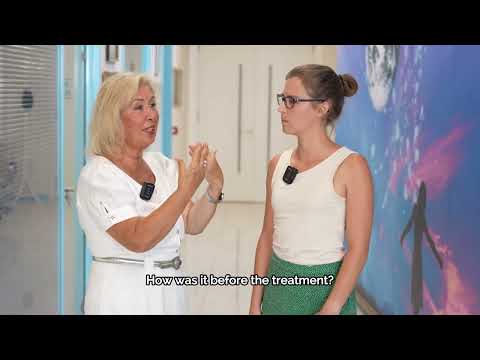
Living with Stargardt: A Patient’s Progress at Fıratlı Clinic